
Taking your pet to the vet can be stressful enough without suddenly having to explain symptoms in French.
You might know plenty of French in everyday life, but then the vet asks a question you weren’t expecting, and your brain decides this would be an excellent moment to disappear completely.
So here are a few useful phrases to help you feel more prepared.
Start simple
When you arrive, you don’t need a complicated explanation.
You can begin with:
Bonjour Madame / Monsieur. Mon chien / mon chat…
Then explain what’s happening.
For example:
Il ne mange plus.
He’s no longer eating.
Elle boite.
She’s limping.
Il se gratte beaucoup.
He’s scratching a lot.
Elle est très fatiguée.
She’s very tired.
Il s’est fait mal à la patte.
He’s hurt his paw or leg.
A short, clear sentence is absolutely fine.
Add when it started
This is something the vet is very likely to want to know.
You can say:
Depuis ce matin.
Since this morning.
Depuis quelques jours.
For a few days.
J’ai remarqué ça hier soir.
I noticed it yesterday evening.
One useful distinction is between something that is still happening and something that happened once.
For something that started in the past and is still going on:
Il boite depuis ce matin.
He’s been limping since this morning.
For a completed event:
C’est arrivé ce matin.
It happened this morning.
Avoir mal or se faire mal?
These two are worth knowing.
Il a mal à la patte.
His paw or leg hurts.
This describes the pain.
Il s’est fait mal à la patte.
He has hurt his paw or leg.
This suggests that something happened to cause the injury.

What the vet might say
You don’t need to be able to produce all of these yourself. Simply recognising them is a really useful start.
Je vais l’examiner.
I’m going to examine him/her.
On va lui faire une prise de sang.
We’ll do a blood test.
On va lui faire une radio.
We’ll take an X-ray.
Je vous fais une ordonnance.
I’ll write you a prescription.
Ce n’est pas grave.
It’s nothing serious.
And one little French time trap:
Revenez dans huit jours.
This often means come back in a week, not eight literal days. If you’re unsure, ask:
À quelle date exactement ?
On which date exactly?
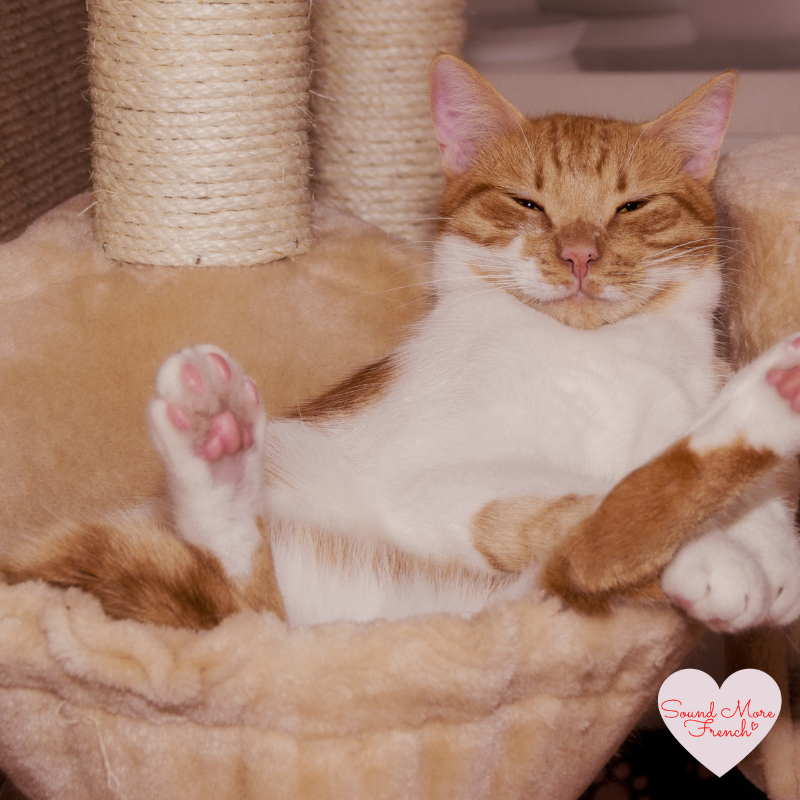
And yes, we need to talk about ma chatte…
Ma chatte is technically the correct way to say “my female cat”, but it also has a rude double meaning.
At the vet, the context is clear, but if you’d rather avoid it, you can say:
ma minette
or simply:
mon chat, c’est une femelle
my cat, she’s female.

Want the full cheat sheet?
We’ve put all of this, plus lots more useful phrases, questions the vet may ask, pet vocabulary, and a handy appointment card into a free printable:
Chez le véto: Your French Vet Visit Cheat Sheet
Keep it on your phone or print it out, because this is definitely one of those bits of French you’d rather have ready before you need it.
Recent Comments