
Because learning to speak French should lead to conversations, not puzzled looks and replies in English.
Picture the scene.
You’re in France. You’ve rehearsed your sentence, checked your vocabulary, remembered which verb goes where and finally summoned up the courage to speak.
You say it.
The French person looks at you.
There’s a pause. A slightly puzzled expression.
“Pardon?”
You try again. Perhaps a little louder this time.
Another pause.
And then comes the response you’ve been dreading:
“Ah, you are English! I speak English.”
Aaaaargh!
You made the effort. You spoke French. You even got the grammar right.
So what went wrong?
Well, it might not have been your vocabulary or your grammar at all.
It might simply have been the sounds you made.
And this is exactly why Judith and I believe that pronunciation should be taught right from the beginning of your French-learning journey, rather than being something you come back to later.
The problem with learning French through English ears
Here’s something that might surprise you.
When you start learning French, your brain doesn’t suddenly develop a whole new set of French sounds.
It works with what it already knows.
And if English is your first language, what it knows is English.
So when you encounter an unfamiliar French sound, your brain does something rather clever but not always terribly helpful.
It tries to match that sound to the nearest one it already recognises.
Sometimes that works reasonably well.
Sometimes it doesn’t.
And sometimes the difference is so subtle to an English ear that you genuinely can’t hear why the French version isn’t quite the same.
Take the French words rue (street) and roue (wheel).
To an English speaker, the vowel sounds might initially seem rather similar. But to a French listener, they’re two distinctly different sounds.
Or consider tu (you) and tout (everything).
Again, the vowel sounds matter.
If nobody shows you how to produce those unfamiliar sounds, you may keep substituting the nearest English equivalent without even realising you’re doing it.
And here’s the really important bit.
The sound you’re making might seem perfectly correct to you, but it may not be the sound your French listener is expecting to hear.
That’s not because you’re hopeless at languages.
It’s because your ears and your mouth have spent years becoming very good at English.
Now we need to help them become good at French, too.
Why pronunciation problems can make conversations so exhausting
Imagine you’re having a conversation with someone who speaks your language but uses several unfamiliar sounds.
You can probably understand them eventually, particularly if you know what they’re talking about.
But your brain may need to work a little harder.
You find yourself listening closely, mentally testing possible words, working out what makes sense in context.
Now imagine being on the other side of that conversation.
You’re desperately trying to remember your French, form a sentence, and say it out loud. Meanwhile, you’re watching the other person’s face for signs that they’ve understood.
If they haven’t, you try again.
And again.
Perhaps you start doubting yourself.
Perhaps you give up and switch to English.
A conversation that should have been enjoyable has suddenly become hard work for both of you.
Of course, pronunciation isn’t the only reason conversations can be difficult. Vocabulary, listening skills, context, and the other person’s familiarity with different accents all play a part.
But pronunciation is a particularly important piece of the puzzle, because it affects whether the words you already know are recognised when you say them.
And when you’re not being understood, it’s very easy for confidence to take a knock.
The confidence problem: why one awkward conversation can affect the next
This is something Judith and I feel particularly strongly about.
When you make the effort to speak French and receive a puzzled look, an impatient response, or an immediate switch to English, it can feel like a rejection.
Even when it isn’t intended that way.
You might start thinking:
My French must be terrible.
I’m making a fool of myself.
Why do I even bother?
And the next time an opportunity comes along to speak French, you hesitate.
Perhaps you say less than you wanted to.
Perhaps you avoid the conversation altogether.
Before long, you’re practising your French less, which makes it harder to build confidence.
It’s a frustrating little cycle.
And we want to interrupt it.
We can’t control how every French person responds, and we certainly don’t believe you need a flawless accent to deserve a friendly conversation.
But we can help you make your words easier to recognise, so that speaking French becomes less of a guessing game for everyone involved.
The goal isn’t to sound French at all costs. It’s to be understood and to enjoy the experience of communicating.
Why wait until you’ve developed bad habits?
Here’s where our approach differs from a lot of traditional beginners’ French learning.
Quite often, pronunciation gets a relatively small amount of attention at the beginning.
You’re introduced to some words, perhaps asked to repeat them, and then it’s straight into greetings, numbers, grammar, and useful phrases.
All important things, of course.
But what happens if you’ve been repeating those phrases using sounds that aren’t quite right?
Well, the more often you say them, the more familiar those particular mouth movements become.
And the more automatic they feel.
Later, when somebody explains that a French vowel is actually made differently, you have two jobs.
First, you need to learn the new sound.
Then you need to stop automatically making the old one.
That’s perfectly possible, and it’s never too late to improve your pronunciation.
But wouldn’t it make sense to start with some useful guidance before those habits become established?
It’s rather like learning to play a musical instrument.
You wouldn’t necessarily expect to master every technique before playing your first tune.
But a good teacher would help you with the basics of how to hold the instrument and produce a sound, so you aren’t spending the next six months practising a technique that’s making everything more difficult.
For us, French pronunciation deserves that same attention from day one.
Your mouth needs to learn French, too!
Here’s something I find fascinating.
Speaking French isn’t just about learning new words. It’s about learning new physical movements.
Your mouth has spent your entire life getting very good at producing English sounds.
And English speakers often approach French with a mouth that’s simply too relaxed for some of the sounds they’re trying to make.
I sometimes describe this as the difference between a rather slack English-speaking mouth and a more tense, controlled French-speaking mouth.
Now, that’s a useful teaching image rather than a rule for every single sound. Both languages use different degrees of muscular tension and relaxation.
But French does ask us to use our lips, tongue, and facial muscles in combinations that may feel completely unfamiliar at first.
Some vowels require much more precise lip rounding.
Others need careful tongue positioning.
And sometimes you need to hold a particular shape more firmly than you’re used to.
At first, it can feel quite peculiar.
Almost as though you’re doing a little workout for your face!
And in a way, you are.
Practising the movements until they become natural
Because when you deliberately practise these unfamiliar shapes, you’re training the muscles and movements involved in producing French sounds.
The more often you practise them correctly, the more familiar they become.
You develop muscle memory, so you don’t have to consciously think about every tiny movement each time you speak.
Eventually, your mouth can begin to find those French shapes more quickly and naturally.
Instead of thinking, Right, where does my tongue go? What are my lips supposed to be doing?, you simply start making the sound.
And that frees up more of your attention for the conversation itself.
We want French sounds to become something your mouth knows how to do, not something your brain has to work out from scratch every single time.
How a rather embarrassing French conversation changed the way I teach
Now, I have a confession to make.
I didn’t arrive at this way of teaching pronunciation because I’d been researching clever teaching methods or studying how to create a new system.
It all began with a rather mortifying discovery about my own French.
I already had a degree in French.
I’d also lived in France for more than a year.
I could speak French. I understood the grammar. I had plenty of vocabulary.
So you can imagine my horror when a kind French friend pointed out that I wasn’t pronouncing tu correctly.
In fact, I was saying tout for both!
Two words that should sound quite different were coming out of my mouth sounding exactly the same.
And I hadn’t even realised it.
I was absolutely mortified.
Here I was, with a French degree and more than a year’s experience living in France, and I couldn’t even pronounce something as basic as tu properly!
But once I’d recovered from the embarrassment, my curiosity took over.
Rather than simply trying to copy what my friend was saying, I started asking questions.
What exactly was happening inside their mouth?
Where was their tongue?
What were their lips doing?
How could they make a sound that I couldn’t seem to reproduce?
And, perhaps even more puzzlingly, why couldn’t I hear the difference between the two sounds in the first place?
That conversation changed everything.
My very own French mouth workout
Once I understood that the French U and OU needed different mouth shapes, I started experimenting.
For OU, I needed rounded lips with my tongue positioned towards the back of my mouth.
For U, my lips were still rounded, but my tongue needed to be much further forward.

Suddenly I had something concrete to practise.
I wasn’t just trying to imitate a sound that my English ears couldn’t distinguish.
I was learning how to make it.
And I threw myself into it.
I made up silly little poems and phrases stuffed full of U and OU sounds.
I practised saying them aloud.
And I kept practising, just for a minute or two at a time, several times throughout the day.
Nothing complicated.
No marathon study sessions.
Just little bursts of focused practice, every day.
I was gradually teaching my mouth to find those unfamiliar shapes and move between them.
And then, after a few months, something rather wonderful happened.
I realised I could actually HEAR the difference.
Not just when I was making the sounds myself.
I could begin to recognise the difference when other people spoke, too.
Sounds that had previously seemed identical were suddenly distinct.
My ears had started to catch up with my mouth.
It felt like discovering a whole new layer of the French language that had been hiding in front of me all along.
And that discovery stayed with me.
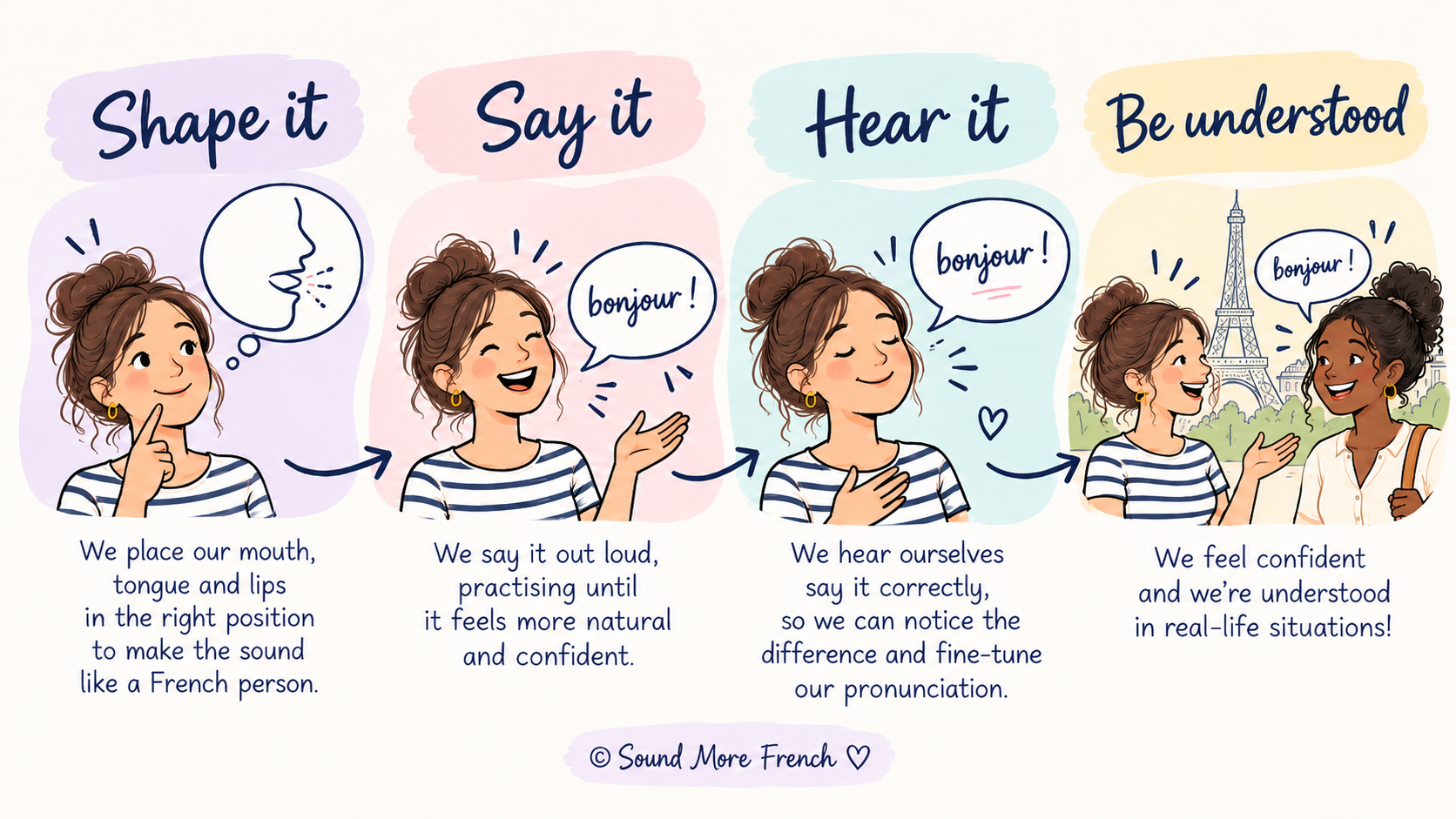
SHAPE, SAY, HEAR: the method I didn’t realise I’d invented
Without knowing it, I’d developed a way of learning pronunciation that involved three interconnected things.
SHAPE: Understand the physical movements needed to make a sound.
SAY: Practise those movements regularly until they become familiar and more automatic.
HEAR: Gradually develop the ability to recognise and distinguish the sounds, including when other people speak.
And here’s the funny thing.
When I started teaching French, I naturally taught pronunciation in exactly the same way.
I showed learners what to do with their mouths.
I helped them practise the sounds.
I encouraged them to notice the differences between sounds that English speakers often find difficult.
I didn’t think there was anything particularly unusual about it.
In fact, I assumed this was simply how you taught pronunciation!
After all, it seemed so obvious to me.
If someone doesn’t know how to make a sound, surely you show them how to make it?
When I realised my teaching approach was different
It was only when I started teaching adults who’d already learned some French that I realised my approach wasn’t something they necessarily encountered elsewhere.
Again and again, students would say things like:
“Nobody has ever explained it to me like that before!”
And I’d think, Really?
They’d spent years learning vocabulary and grammar, sometimes attending classes and practising regularly.
Yet nobody had shown them what was physically happening in their mouths when they spoke French.
Nobody had explained why two sounds that seemed identical to their English ears were actually different.
And suddenly, things started making sense to them.
That was my lightbulb moment.
I realised that something I’d been doing instinctively, almost without giving it a second thought, was making an important difference to how my students understood pronunciation.
And that’s when SHAPE, SAY, HEAR was born.
Not out of a complicated theory.
But out of personal experience, curiosity, a lot of silly poems and a very patient French friend!
Why your ears sometimes need time to catch up
There’s another important lesson in my story.
You don’t have to hear a French sound perfectly before you can begin learning how to make it.
Sometimes, learning the physical movements can actually help you develop your listening skills.
Think about French U and OU again.
If your English-trained brain initially treats both sounds as belonging to the same category, endlessly listening to them may leave you feeling frustrated.
But when you deliberately practise the different tongue positions and lip shapes, you’re giving your brain more information to work with.
Connecting what you see, say and hear
We also make a connection with spelling.
When you see OU, you learn which mouth shape and sound go together.
When you see U, you learn a different one.
You’re gradually connecting three things:
What you SEE on the page.
What your MOUTH is learning to do.
What your EARS are learning to recognise.
And through that combination of focused practice and listening, your perception can begin to change.
You may start hearing a difference in your own voice.
Then when somebody demonstrates the sounds.
And eventually when French people use them naturally in conversation.
This doesn’t necessarily happen overnight.
It certainly didn’t for me.
And it may take some people much longer than others.
That’s why I always encourage learners to be patient.
A minute or two of focused pronunciation practice, repeated regularly, can be far more useful than getting cross with yourself because you can’t hear something immediately.
Keep returning to the shapes.
Keep saying the sounds.
Keep listening for the differences.
Give your ears time to catch up with your mouth.
Because when you can begin to both produce and recognise those sounds, you’re developing two essential skills together.
Not just speaking French more clearly.
Understanding spoken French more easily, too.
Curious about learning French with pronunciation at the heart of everything?
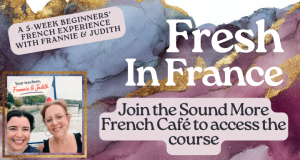
Take a look at Fresh in France, our new beginners’ course.
But surely grammar and vocabulary are more important?
We certainly aren’t suggesting that pronunciation is the only thing beginners need.
You still need vocabulary.
You still need to understand how French sentences work.
And you need opportunities to use what you’re learning in situations that mean something to you.
But here’s how Judith and I see it.
Learning more words is wonderful.
Being able to use those words in a real conversation is even better.
If you know exactly what you want to say but the person you’re speaking to can’t recognise the words, that vocabulary isn’t doing quite the job you hoped it would.
Pronunciation helps turn what you know into something another person can understand.
How real conversations help your French improve
But there’s another benefit that I think is just as important.
When your pronunciation is easier to understand, conversations have a better chance of flowing naturally.
Your French listener doesn’t have to spend quite so much effort trying to decipher every word.
And when conversations feel easier for both people, they’re often more enjoyable.
The other person may be more inclined to carry on chatting, ask you another question, tell you something about themselves or help you find the word you’re looking for.
And suddenly, something rather wonderful is happening.
You’re learning more French by actually speaking French.
You’re hearing new vocabulary in context.
You’re noticing how native speakers put sentences together.
You’re picking up useful expressions that you might never encounter in a textbook.
You’re getting opportunities to try out grammar you’ve learned, hear how people respond and gradually develop a more natural feel for the language.
And because these are positive interactions, you’re more likely to want to have another go.
So your confidence grows.
Your vocabulary grows.
Your understanding of grammar grows.
And the language starts to become something you use, rather than something you simply study.
Of course, speaking with native French speakers doesn’t replace learning grammar and vocabulary. You’ll still benefit from studying both.
But real conversations give all that knowledge somewhere to live.
Good pronunciation can help open the door to the very conversations that make the rest of your French better.
And isn’t that a rather lovely reason to start with it?
We don’t want perfect French. We want real French conversations.
Let’s be clear about something.
Neither Judith nor I believe that you need to speak with a perfect French accent.
Perfection isn’t the goal.
We’re far more interested in what happens when you walk into your local boulangerie, speak to a neighbour, ask a question in a shop or make a little conversation in a café.
Can you say what you want to say?
Does the other person understand you?
Can the conversation carry on without too much effort?
And, perhaps most importantly, do you come away feeling pleased that you had a go?
That’s what matters to us.
Because every successful little interaction helps you feel more comfortable using French the next time.
And the next.
And the next.
Those little moments can add up to something rather wonderful.
Instead of feeling like a visitor standing on the outside of everyday French life, you begin to feel more involved in it.
You stop merely getting by.
You start connecting.
Why Judith and I have created Fresh in France

All of this thinking is at the heart of our new beginners’ French course, Fresh in France.
We wanted to create something that puts pronunciation and speaking confidence at the centre of learning from the very beginning.
Not as an optional extra.
Not as something to sort out once you’ve learned enough grammar.
But as part of how you learn to speak French from day one.
I’m bringing my focus on understanding, hearing and producing French sounds.
Judith brings the practical, confidence-building side, helping learners connect what they’re studying to everyday situations and giving them opportunities to put their French into practice.
Together, we’re combining how to make yourself understood with the confidence to have a go.
Fresh in France is a five-week online beginners’ course with ten lessons you can work through at your own pace, plus five optional live Practice Labs where you can practise what you’re learning.
It’s designed to help you begin using essential everyday French with clearer pronunciation, growing confidence and a much better understanding of how those unfamiliar sounds actually work.
We want you to feel ready to try your French in real life, whether that’s saying hello to your neighbour, ordering something in a café or asking for help in a shop.
And if you’ve already learned a little French but have never really understood how to make the sounds, some of the foundations may be useful for you too.
A final thought
If you’ve ever come away from a conversation in France feeling embarrassed, frustrated or thoroughly fed up because somebody didn’t understand you, I’d love you to remember something.
It doesn’t mean you’re incapable of learning French.
It might simply mean that nobody has ever shown you how some of those French sounds are actually made.
And that is something you can learn.
You don’t need to be perfect.
You don’t need to lose your accent.
You don’t need to wait until you’ve memorised a mountain of grammar.
And you certainly don’t need to hear every unfamiliar French sound perfectly from your very first lesson.
You can learn the shapes.
You can train your mouth.
You can give your ears time to catch up.
And gradually, you can build the pronunciation skills and confidence that make real conversations more enjoyable.
You just need a good place to begin.
And for Judith and me, that place is pronunciation.
Because we don’t just want you to know French words. We want you to feel confident using them, and to enjoy what happens next.
Curious about Fresh in France?
Our five-week beginners’ course starts in January 2027, with a special founding price of $179 until 15 December 2026.
If you’d like to discover how Judith and I are bringing pronunciation and confidence together from the very beginning, you can find all the details here:
À bientôt,
Frannie x
Recent Comments