

Boxing Day is often slower, quieter, and filled with food. Plates of leftovers, half-opened boxes of chocolates, and the question of what to eat next.
It is also a lovely moment for a small but satisfying French pronunciation tip!
Today, we are looking at French pronunciation and the letter U, a vowel that sometimes takes on a very important role protecting other letters.

French pronunciation and the letter U: the bodyguard vowel
In French pronunciation, the letter U can act like a silent bodyguard, protecting the letters G and C from the “smooth operator” vowels E and I.
Normally, when G or C sit next to E or I, their pronunciation softens:
-
G sounds like j (ZH)
-
C sounds like s (SS)
But when U steps in between, it changes everything.

The U blocks the softening effect and keeps the consonant hard — G stays [g], and C stays [k]. The U itself is usually silent, but its role is crucial. It isn’t there for decoration; it’s there to control the sound.
Once you understand this “bodyguard U”, many French words suddenly become easier to recognise, pronounce, and remember.
Watch my short video where I explain this rule with clear examples >>here.
Seasonal examples you will recognise
Let’s start with a very Christmassy one.
Le gui (said GEE – with a hard G sound)
Mistletoe in French is le gui.
The U sits between G and I and keeps the G hard.
Another word you have probably seen everywhere over the past few weeks is:
Une guirlande (said GEERLO(N)D – with a hard G sound)
A garland/tinsel, whether it is still on your tree or waiting to be packed away.
Once again, the French pronunciation letter U is protecting the G from becoming soft.
And now for something sweet.
Les guimauves (GEEMOHV – again with a hard G).
Marshmallows, often enjoyed with hot chocolate or as a festive treat.
Here too, the U sits quietly between G and I, keeping the G sounding strong.
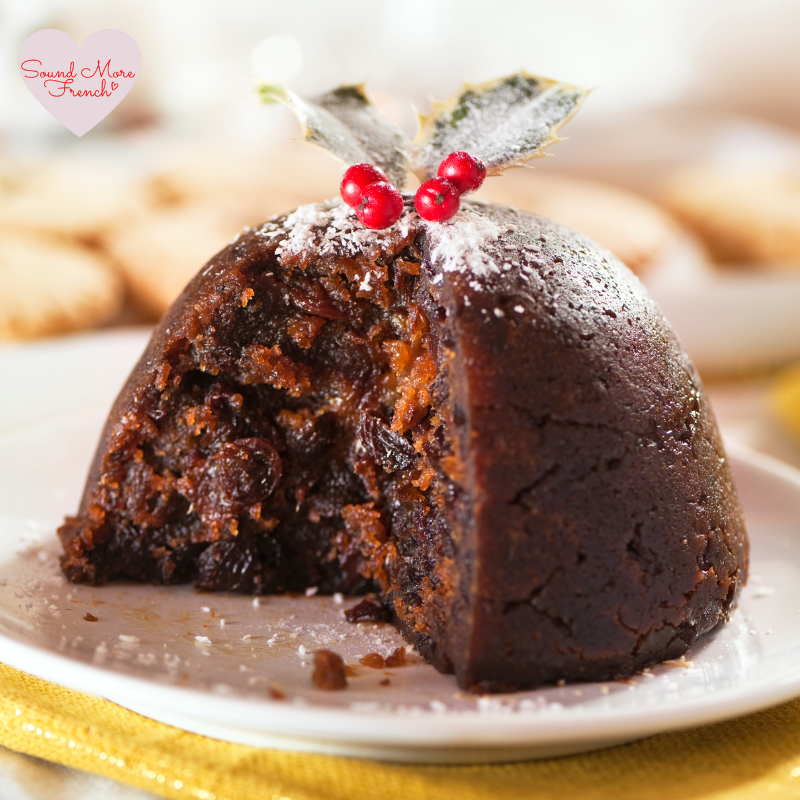
Boxing Day food and les restes
Boxing Day in France and elsewhere is also about food and more food.
And, of course, leftovers.
In French, leftovers are called les restes.
You might be enjoying leftover turkey, vegetables, cheese, chocolate, or perhaps turning yesterday’s meal into something new.
Food vocabulary is a brilliant place to practise French pronunciation because these words tend to stick. They are linked to pleasure, comfort, and routine.
Here are a few food-related words where the letter U acts as a bodyguard:
Une baguette
The U keeps the G hard before the E.
La meringue
Meringue. The U steps in to ensure the G does not become soft.
La cuisine
Here, the U not only protects the C, it also teams up with the I to make a [kɥi] / “kwee” sound.
Un biscuit
Once again, the U is keeping the C hard and making a [kɥi] / “kwee” sound with the I.
These are everyday words you may already know, but noticing the role of the U can help you say them with more confidence.

Why this matters for sounding more French
Understanding small rules like this is what helps you stop guessing and start trusting yourself.
You are no longer hoping a word sounds right. You understand why it sounds the way it does.
That is a big step towards sounding more French and feeling more relaxed when you speak.
A little Boxing Day challenge
As you enjoy your restes today, see if you can spot another French word where the letter U is acting like a bodyguard.
Pop your ideas in the comments below. I would love to see what you come up with.

If you would like more bite sized French pronunciation tips, you can join my mailing list. If you are curious about practising your spoken French in a friendly, supportive space, you can also find out more about my membership, the Sound More French Café.
And if you are thinking about starting the new year with regular French practice, my Speech Bubble French language classes restart in the week beginning 5th January 2026. There are not many spaces left, but we do have a few places available at each level.
If you would like to secure a spot, get in touch as soon as possible, and I will let you know what is available.
À bientôt, and enjoy the rest of your Boxing Day!
Frannie x

Join Our Language Learning Community
Remember you’re not alone in your language learning journey. Our vibrant community of learners is always here to support you. Join us in our free Facebook group Sound More French with Frannie, to share tips, ask questions, and connect with like-minded learners.
Je doit cuir des légumes frais pour accompagner les restes de viande.
Je peux écouter des musiques guitare pendant je suis dans la cuisine.
Grâce et bon fête !
Bonnes fêtes à toi aussi, Joy !